


Our Baie-Johan-Beetz deposit is known as The Crête White property

The Property is located 11.2 km east of the community of Baie-Johan-Beetz along Route 138 in northeastern Québec, approximately 270 km east of Sept-Îles and 62 km east of Havre-Saint-Pierre.
This well-maintained regional highway provides year-round access to the Property, with Route 138 situated approximately 850 meters from its center.
There is no overburden covering the main veins, and the top of the hill rises approximately 37 meters above sea level. This hill is called Crête White, which is why the deposit is referred to as the Crête White Property.
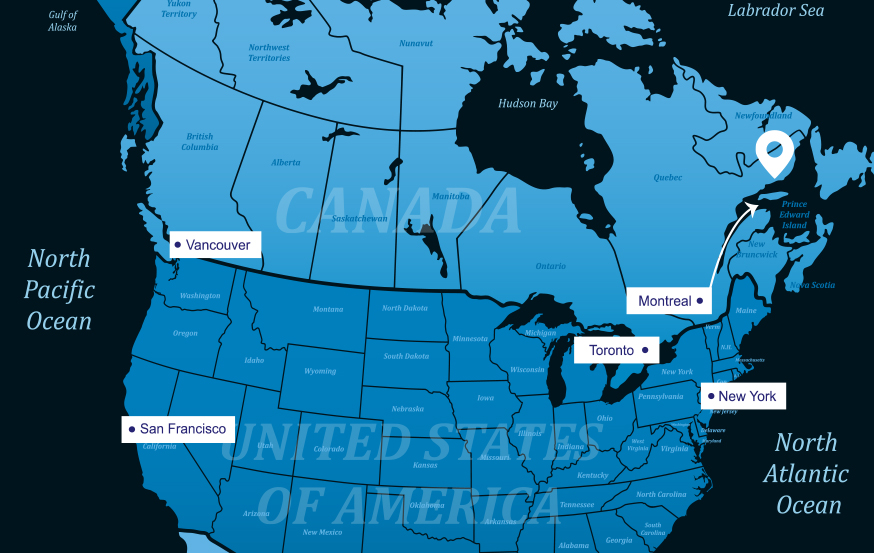
In 2019, the Fraser Institute ranked Quebec Mining market as the 4th most attractive area in the world for mining investment.
Our Baie-Johan-Beetz pegmatite deposit in video
4 key advantages of Baie-Johan-Beetz deposit.
01. Location Opportunity
- 15km east of the village Baie-Johan-Beetz
- Deposit is less than 800 meters from main provincial road (route 138)
- 69 km from town of Havre-St-Pierre and its airport
- Several deepwater seaport options within 69 km
02. Easy Operation
- Open pit operation
- Scarce surface vegetation
- Available local man power
03. Business Opportunity
- Advantageous governmental policies due to surface deposit type operation
- Possible support from local and state governments
- Social acceptability from local First Nation and Baie-Johan-Beetz community
04. Sustainable Footprint
- Potentially low carbon footprint final product depending on operation
- HPQ is a critical mineral for the solar panel industry and in various other climate change fighting technologies
Geology & Mineralogy
Johan-Beetz area geology consists mainly of quartzite, gabbro, and granitic gneiss. The Property is located in the Baie-Johan-Beetz region, where most rock formations are metamorphosed sedimentary rocks dating from the early Precambrian period.
The northern portion of the area is characterized by a north–south structural trend that abruptly deviates toward a southwest–northeast orientation near the coastline. This sector is also marked by the presence of two successive anticlines and synclines whose amplitudes decrease toward the coast. These structures reflect the tectonic activity that affected the region during the early stages of continental formation.
Two distinct facies have been identified based on differences in the original sediments that later underwent metamorphism during the Grenville orogeny, which occurred between 1300 Ma and 900 Ma, at the end of the Mesoproterozoic and beginning of the Neoproterozoic periods. One facies occupies the southern coastal area, while the other dominates the northern part of the region.
The quartzite–amphibolite complex was thrust against the coastal granitic gneiss during deformation, causing recrystallization of the mineral assemblage within the quartzite—composed predominantly of quartz. This process generated medium- to coarse-grained quartz pegmatite that filled fractures associated with the anticline structures. Most impurities were removed during metamorphism and recrystallization, leaving at the top of the hill a massive accumulation of high-purity white quartz.
The brecciated quartz–paragneiss contact observed along the ridge provides further evidence of this geological evolution, which culminated in the formation of a pure quartz pegmatite body.
The Grenville Province, where the Johan-Beetz quartz deposit is located, hosts several other quartz deposits, though most present lower purity and less homogeneous characteristics.